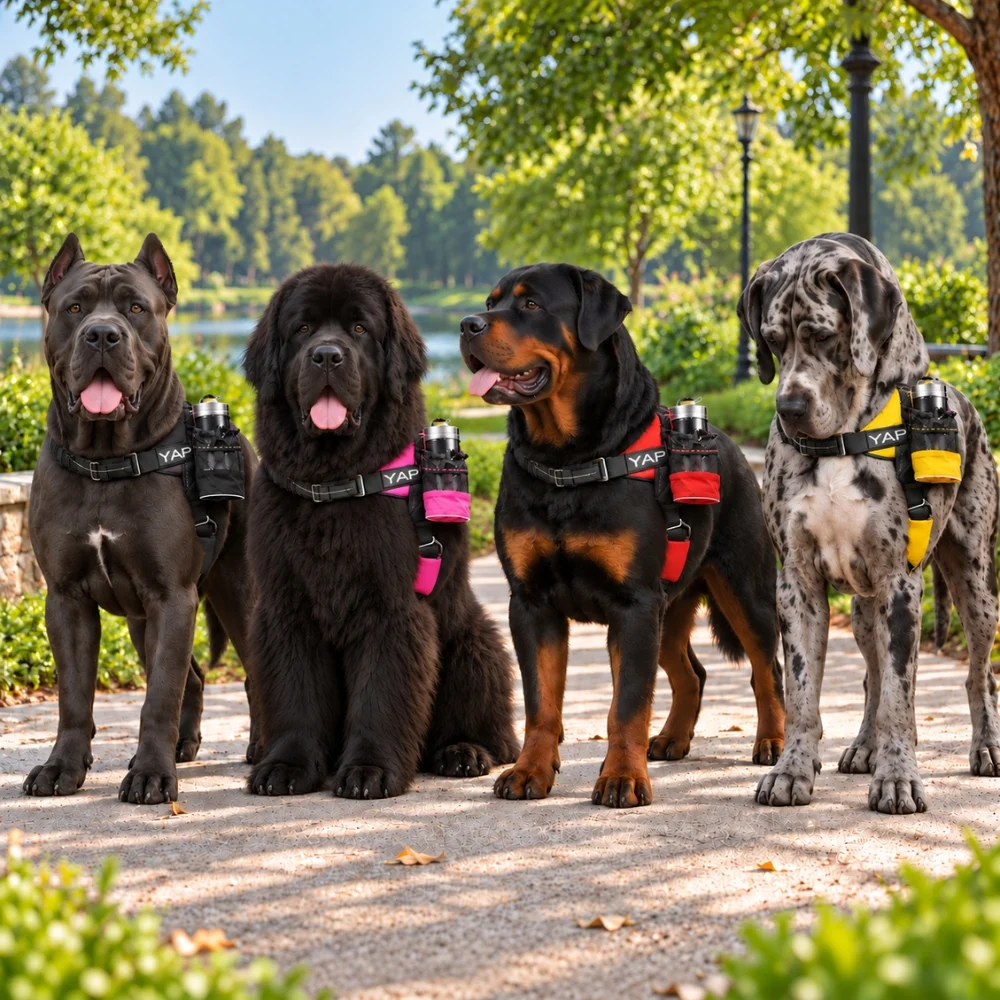
Home / Dog Harnesses / Best Harness for a 150 lb Dog Finding the Best Harness for a 150 lb Dog YAP USA Editorial Pet Gear Specialists September 2026 8 min read A reinforced harness gives a large, strong dog real control without pressure on the neck. A dog at 150 lbs is not a small pull. That much weight and strength behind a lunge can put real force on a leash, a handler, and the dog’s own body if the equipment is not built for it. This guide covers the best harness for a 150 lb dog, why heavier and stronger breeds need different engineering than a small dog does, and how to size and fit one correctly. Key Takeaways The best harness for a 150 lb dog spreads pulling force across the chest and shoulders instead of the neck. Reinforced stitching and load tested hardware matter more as a dog’s size and pulling strength go up. The Beta Noir Package supports dogs from 40 to 175 lbs and was tested with police, military, and American Kennel Club dogs. A reinforced top handle gives close, two handed control for a strong dog that leans into every walk. YAP USA harnesses are made in the USA with reinforced stitching and a thirty day exchange window. Why Weight Changes What a Harness Needs to Do A small dog pulling against a leash puts limited force behind it. A 150 lb dog pulling at full strength is a different situation entirely, and the harness has to hold up to that force without slipping, twisting, or putting all the pressure back on the neck. This is why hardware quality and stitching strength matter as much as size range once a dog crosses into large and giant breed territory. A collar on a dog this size concentrates the full force of a lunge on the neck, right where the trachea and spine sit close to the surface. A well built harness moves that same force to the chest and shoulders, the strongest part of a dog’s frame, which protects the dog and gives the handler far more control during a sudden pull. This is the core job the best harness for a powerful dog has to do before any other feature matters. Good to know: A harness does not train a dog out of pulling on its own. It removes the added neck pressure and gives the handler a more secure point of control while training continues. What Makes the Best Harness for a Heavy, Strong Dog Reinforced hardware and a control handle matter more as a dog’s pulling strength increases. Not every harness on the market is built to hold up to 150 lbs of pulling force. A few features separate a harness made for the job from one that is simply sized up. Reinforced Control Handle A sturdy top handle gives close, two handed control in a crowded space or a sudden lunge. Load Tested Hardware Buckles and stitching rated for heavy, active use hold up to repeated strain without stretching. Sound Canceling Components Quiet hardware keeps a strong dog focused on the handler instead of reacting to rattling metal. Anti Static, Chafe Free Build Material that resists static and rubbing stays comfortable during long walks and daily wear. Even Pressure Distribution Pressure spreads across the chest and shoulders instead of concentrating on the neck. Escape Resistant Fit A secure, adjustable wrap makes it harder for a strong dog to twist or back out mid walk. Top Pick: The Best Harness for a 150 lb Dog The Beta Noir Package was tested with police, military, and American Kennel Club dogs.Beta Noir Package The Beta Noir Package harness is one of the best harness options for a dog at 150 lbs because it supports dogs from 40 to 175 lbs and was tested with police, military, and American Kennel Club dogs. A reinforced top handle gives close, two handed control, and sound canceling components keep movement quiet so a strong puller stays focused on the handler instead of the noise around them. The build includes anti static construction to reduce static shocks and chafing during extended wear, and a waste bag and bottle holder are included for daily walks. It is heavier than a lightweight vest style harness, which is expected given the reinforced hardware, and it is more harness than a small or calm dog needs, but for a powerful 150 lb dog that leans into every walk, it is built to hold. Alternative Pick: Techno Harness For an owner who wants a lighter, more streamlined option that still covers a 150 lb dog, the Techno Harness fits the same 8 to 175 lbs range and uses NASA certified Outlast fabric to manage body temperature. It includes a built in emergency handle and curved buckles that sit flat against the body, though it does not carry the same reinforced control handle or sound canceling build as the Beta Noir Package. Comparing the Best Harness Options for Large Dogs Both harnesses are made in the USA with reinforced stitching, and the choice comes down to how much control hardware a 150 lb dog actually needs day to day. Either one is a genuine best harness contender depending on how much of a puller your dog tends to be. Harness Best For Size Range Handle Temperature Control Beta Noir Package Strong, powerful large breeds 40 to 175 lbs Yes, reinforced Airflow option Techno Harness All around use, lighter build 8 to 175 lbs Yes NASA Outlast fabric Sizing and Fit Guide Match your dog’s chest girth and neck measurement to the product size chart before ordering. Getting the size right matters as much as choosing the best harness in the first place. Measure your dog’s chest girth at the widest point just behind the front legs, then measure the lower neck where the harness will sit. Compare those numbers to the size chart on the product page rather than guessing by breed, since

Home / Dog Harnesses / Best Harnesses for a French Bulldog Finding the Best Harnesses for a French Bulldog YAP USA Editorial Pet Gear Specialists September 2026 8 min read A properly fitted chest harness keeps pressure off a short nosed breed’s airway. A French Bulldog has a short nose and a compact chest, and that shape changes what a harness needs to do. The breed is brachycephalic, which means the skull and airway are shorter than average, so the neck is not the place to put any leash pressure. This guide walks through the best harnesses for a French Bulldog, why chest support matters more for this breed than most, and how to size and fit a harness the right way. Key Takeaways The best harnesses for a French Bulldog move leash pressure off the neck and onto the chest and shoulders. A collar concentrates force on the throat, which is risky for a breed that already works harder to breathe. The Techno Harness fits dogs from 8 to 175 lbs and uses NASA certified Outlast fabric to manage body heat. Correct sizing and the two finger rule under every strap keep the fit snug without restricting breathing. YAP USA harnesses are made in the USA with reinforced stitching and a thirty day exchange window. Why French Bulldogs Need the Right Harness French Bulldogs carry a shortened muzzle and a narrower airway than most breeds, a trait veterinarians describe as brachycephalic conformation. Because of this, extra pressure on the throat can make an already hard working airway work even harder. A collar places the full force of a pull directly on that airway, right where the trachea sits close to the surface. A harness changes where that force lands. Instead of one narrow point at the neck, a well fitted harness spreads pressure across the chest and shoulders, the strongest part of a dog’s frame. This is one reason vets and trainers point owners of flat faced breeds toward a harness first, and it is the starting point for choosing the best harnesses for this breed. A properly fitted Bulldog harness also stays in place better than a slim collar, since the wider chest wrap makes it harder for a stocky, short necked dog to back out mid walk. Understanding the Breathing Challenge The shortened skull that gives a French Bulldog its familiar look also narrows the nasal passages and windpipe compared to a longer nosed dog. This means the breed already puts in extra effort with every breath, especially during exercise, heat, or excitement. Any added pressure at the throat, even brief tension from a leash, adds one more obstacle on top of that natural workload. This is why so many veterinary resources recommend chest support over neck pressure for flat faced breeds. It is not about one bad walk causing harm. It is about removing a source of daily strain so the breed’s naturally busy airway has one less thing working against it, which is exactly the job the best harnesses are built to do. Good to know: A harness does not treat any breathing condition on its own. It simply removes the added throat pressure that a collar creates during normal daily walks. What Makes the Best Harnesses for French Bulldogs Chest routing, even pressure, and breathable fabric define a harness built for a short nosed breed. Not every harness on the market earns a spot among the best harnesses for a compact, short nosed breed. A few features separate a harness built for the job from a generic vest. Choke Free Chest Routing The chest strap sits below the throat entirely, so leash tension never reaches the airway. Even Pressure Distribution Pressure spreads across the body’s natural balance point instead of one spot, keeping the gait steady. Breathable, Anti Static Fabric A fabric that resists static and chafing keeps daily wear comfortable on a short, dense coat. Temperature Regulation Material that manages heat helps avoid adding extra stress during a walk for a breed that overheats fast. Secure Adjustable Straps Multiple adjustment points keep the fit snug without pressing into the armpits or throat. Emergency Handle A built in handle lets an owner guide or steady a dog with zero pressure on the neck. Top Picks: The Best Harnesses for a French Bulldog The Techno Harness routes pressure to the chest for dogs from 8 to 175 lbs.Techno Harness The Techno harness from YAP USA is one of the best harnesses for a French Bulldog because it fits the full range of adult Frenchie weights within its 8 to 175 lbs size window. It is built with NASA certified Outlast fabric, the same phase change material developed for astronaut spacesuits, which stores and releases heat to hold a steady, comfortable temperature. That matters for a breed that overheats faster than most. The Techno Harness distributes pressure evenly across the body to prevent strain on the neck or spine, and curved buckles sit flat against the body to prevent rubbing during extended wear. A built in emergency handle allows a lift on demand moment without any pressure on the throat, and the anti static construction cuts down on the static shocks that can startle a short coated dog during dry weather. Baby Beta AirFlow For a lighter framed French Bulldog or a young puppy still growing into an adult size, the Baby Beta AirFlow is built for dogs weighing 5 to 40 lbs. It keeps pressure completely off the throat while adding airflow channels that help manage body heat, along with a pocket that silences jingling ID tags so a nervous dog is not startled mid walk. Comparing the Best Harnesses for French Bulldogs Both options below route pressure to the chest instead of the throat and are made in the USA with reinforced stitching, which is the foundation that any of the best harnesses for this breed should share. Harness Best For Size Range Handle Temperature Control Techno Harness All around use, adult Frenchies

Paws and Tales No Pull Dog Harness: How to Stop the Pull Without Choking Your Dog ✍️ YAP USA Team 📅 2026 Guide ⏱️ 12 min read A no pull dog harness stops the lunging and choking that a collar creates by moving every ounce of leash pressure off the throat and onto the chest. This 2026 guide explains how the design works, who needs one, and how to fit it correctly. Every walk turns into a battle when your dog throws its full weight against the leash. A collar answers that pull by driving the force straight into the throat, right where the windpipe and major blood vessels sit close to the surface. A no pull dog harness answers it differently. It spreads the same force across the chest and shoulders, the strongest part of a dog’s frame, so the pull that would choke a collar-wearing dog barely registers. Key Takeaways A true no pull harness routes leash pressure to the chest, never the throat, protecting the trachea and spine. Collars concentrate force on the neck, which is linked to a collapsed windpipe in small breeds. YAP USA harnesses use center-of-gravity science to keep the gait balanced and choke free. The right pick depends on size: Techno for all-around, Baby Beta for small dogs, Beta Noir for large breeds, K9i for working dogs. Correct fit matters as much as the design — always measure first and use the two-finger rule. Quick answer: The best no pull dog harness redirects forward motion without choking, distributes pressure across the chest, and stays secure without shifting. It protects the trachea, spine, and hips on every walk, and it works for a small terrier and a large working breed alike. How a No Pull Dog Harness Actually Works The phrase gets used loosely, so it helps to be precise. A true no pull dog harness does not punish your dog for pulling. It removes the reason pulling causes harm in the first place. Instead of letting leash tension land on a single narrow point at the neck, the harness routes that tension to the chest and shoulders, where muscle and bone can absorb it safely. YAP USA takes this further with a center-of-gravity structure. The harness sits at the exact point where your dog’s weight naturally balances, so leash pressure never throws the gait off or pulls the body sideways. The result is a dog that walks in a straight, balanced line rather than one that leans, coughs, and strains against the throat with every step. Why a Harness Protects Better Than a Collar When a dog lunges against a collar, the pressure concentrates on the neck, where the trachea, thyroid, and major blood vessels sit close to the surface. Over time that repeated strain causes real damage, and small breeds with delicate airways feel it worst of all. According to the American Veterinary Medical Association, repeated tracheal pressure from collars is linked to a collapsed windpipe, especially in toy and small breeds. A well-built harness moves that load to the chest, so the same pull that would choke a collar-wearing dog barely registers. If you want the full breakdown, our guide on dog harness vs collar safety covers it in detail. Six Features That Define a Real No Pull Harness Not every product labeled “no pull” earns the name. Here is what separates a genuine choke-free harness from a generic vest. 1. Choke-Free Chest Routing The chest strap sits below the throat entirely, so leash tension never reaches the windpipe. This is the non-negotiable foundation of any no pull design. 2. Center-of-Gravity Fit Pressure spreads across the dog’s natural balance point rather than one spot, keeping the gait even and reducing fatigue for both dog and handler. 3. Anti-Static Fabric Static buildup startles dogs and disrupts movement. Anti-static material keeps the coat calm and free of irritation during walks. 4. Temperature Control Active dogs overheat fast. Fabric that regulates heat keeps body temperature stable on long walks and in warm weather. 5. Secure Adjustable Straps A harness that slips creates friction and rubbing. Locking adjustment points hold the fit snug without restricting motion. 6. Emergency Handle A built-in handle lets you guide or lift your dog instantly in a tight spot, with zero pressure on the neck. Every YAP USA harness builds all six features into the design, made in the USA with reinforced stitching and hardware tested under load. Before you buy, it helps to measure your dog for a harness so the fit is right the first time. Top No Pull Dog Harnesses for 2026 Each harness below was chosen for its engineering, size range, and the safety features that make it a true no pull design. All come from YAP USA’s current lineup. 1. Techno Harness — Best All-Around No Pull Harness The Techno Harness is YAP USA’s flagship and the most versatile no pull option available. It fits dogs from 8 to 175 pounds, one of the widest ranges on the market, and uses NASA-certified Outlast fabric first developed for astronaut spacesuits. That material absorbs heat when your dog runs warm and releases it when they cool, holding a stable temperature without bulk. A built-in emergency handle lets you steady your dog without any pressure on the neck, and curved buckles sit flat against the body to prevent rubbing. It also clips straight to YAP USA’s Universal Seat Belt for safe car travel. For most households, this is the first harness to consider. Pros Fits the widest range, 8 to 175 lbs NASA Outlast temperature control Built-in emergency handle Car seat belt compatible Cons Premium price versus basic vests More features than a casual walker may need Shop Techno Harness 2. Baby Beta AirFlow — Best No Pull Harness for Small Dogs The Baby Beta AirFlow is built for dogs weighing 5 to 40 pounds, covering most toy and small breeds from Chihuahuas to Cocker Spaniels. Small frames are the most vulnerable to throat pressure, so this

A practical guide to dog seat belts: how car restraints work, how to install one correctly, and which YAP option fits your vehicle.

Home / Paws and Tales / Top 6 Stylish Dog Carriers for 2026 Top 6 Safe and Stylish Dog Carriers Options for 2026 YAP USA Editorial Engineered Products for Exceptional Dogs June 2026 13 min read Choosing the right carrier is about more than looks. It needs to keep your dog safe, comfortable, and calm, whether you are boarding a flight, walking through a busy city, or running errands on a quiet afternoon. The best Stylish Dog Carriers manage to do both at once, pairing thoughtful engineering with a clean, modern look. This guide rounds up six safe and Stylish Dog Carriers worth considering for 2026, each built by YAP USA for a different kind of trip. From an airline approved bag to a hands free backpack, a luxury purse, and a lightweight sling, there is an option here for nearly every dog and every routine. Everything below is grounded in how each carrier is actually built, so you can choose with confidence. Key Takeaways The best Stylish Dog Carriers combine safety features, comfort, and a clean modern look in one design. Options range from an airline approved bag and hands free backpacks to a luxury purse and a lightweight sling. Most YAP carriers include a built in safety hook or strap to keep your dog securely positioned. Match the carrier to your dog’s size and your routine, from flights to short everyday walks. YAP USA is a Made in USA brand, with technology protected under U.S. Patent No. 10,028,486 B1 and U.S. Patent No. 10,321,661 B2. What Makes a Dog Carrier Both Safe and Stylish Before the list, it helps to know what separates a great carrier from a basic bag. Safety comes first: look for a secure interior attachment that keeps your dog positioned, full airflow so they stay comfortable, and a structure that protects without feeling rigid. Style follows from good design rather than decoration, with clean lines, quality materials, and a shape that looks as good on your shoulder as it feels. The best Stylish Dog Carriers bring these together so you never have to choose between the two. Across the YAP range, you will see recurring safety features like internal safety hooks, chin rests for comfort, and full airflow, paired with modern finishes and considered color options. Matching those features to your dog and your routine is what makes the final choice easy. It also helps to think about how your dog reacts to being carried. Some dogs love facing outward and watching the world go by, which suits a backpack or sling, while others feel calmer in a more enclosed, private space, which points toward a structured bag or purse. The six options below cover that full spectrum, so there is a comfortable fit for confident dogs and nervous ones alike. 1. Sports Dog Backpack for Active Travel The Sports Dog Backpack is designed for pet owners who want hands free movement without compromising comfort or stability. Built as a true dog carrier backpack, it uses a full two strap design that distributes weight evenly across both shoulders, reducing strain during longer outings. Practical details make it genuinely usable. Full height zippers open completely so your dog can step in naturally without lifting or awkward positioning, and an internal safety hook keeps your dog safely positioned while you move through crowds or over uneven terrain. Integrated chin rests let your dog relax and look out comfortably, peripheral ventilation layers maintain steady airflow, and internal and external pockets keep essentials organized. It comes in Blue and Gray, Neon Yellow, Pink, Ruby, and Steel Gray. The structure strikes a useful balance, staying rigid enough to protect your dog yet flexible enough to fold down for storage between trips. That makes it a practical everyday carrier rather than something that only comes out for big adventures. For owners who want their hands free for trekking poles, luggage, or simply better balance on the trail, this two strap design is one of the most comfortable ways to bring a dog along. 2. Incognito Dog Carrier for Air Travel For anyone who flies with their dog, the Incognito Dog Carrier delivers quiet confidence for pets and owners who travel often. As an airline approved dog carrier, it qualifies as a carry on with all major airlines and fits neatly under the seat to keep your pet close and calm during flights. It is engineered for real journeys. Full height zippers allow stress free entry, dual chin rests on both sides let pets relax and look out, and peripheral airflow layers support steady ventilation without drafts. A built in safety hook keeps pets safely tethered inside, and the bag attaches directly to rolling luggage so terminals are easier to navigate, while the lightweight design reduces carry fatigue. Internal and external pockets hold documents and treats, and it comes in Gold, Purple, Red, and White and Blue. The thoughtful touches add up on travel days. Being able to clip the bag onto your suitcase frees your hands for boarding passes and security trays, and the under seat fit means your dog stays right at your feet rather than out of reach. For frequent flyers, that blend of compliance, comfort, and quiet confidence is exactly what makes air travel with a dog far less stressful. 3. Yap Sak for Small Dogs Up to 30 Pounds The Yap Sak is a balanced, secure backpack carrier designed for smaller dogs. As a dedicated small pet carrier, it supports dogs up to 30 pounds and uses a patented load distribution design, so your dog’s weight is shared between the shoulder straps and gentle compression at the lumbar strap. That balance reduces strain on your back and improves comfort during longer use. It can be worn on either side of the body, and dogs face outward so they stay engaged with their surroundings while remaining supported. The chin height adjusts to suit your dog’s posture, and the chin rest is removable for customized comfort. A

Home / Paws and Tales / Carrier Bags Best Yap Sak Dog Carrier for Travel, Hiking and Everyday Use YAP USA Editorial Engineered Products for Exceptional Dogs June 2026 15 min read Moving through the world with a small dog requires more than just a basic carrier. You need something engineered for both comfort and balance, a solution that keeps your companion secure while distributing weight evenly across your body. The Yap Sak dog carrier represents exactly this kind of thoughtful design, combining patented engineering with practical features that work for real life. This guide explains what makes this carrier different, how its engineering principles reduce physical strain, and why it has become the choice for owners who understand that carrying comfort matters just as much as the security of the animal being carried. Key Features at a Glance Balanced backpack design using patented load distribution technology between shoulders and lumbar region. Supports dogs weighing up to 30 pounds with proper sizing across five different size options. Worn on either side with dogs facing outward for full engagement with surroundings. Adjustable and removable chin rest provides customized positioning for individual comfort. Multi-point closure system using buttons, zippers, and Velcro prevents escape and shifting. Built-in safety strap keeps dogs secure without creating feelings of confinement or stress. Why a Dedicated Dog Carrier Makes a Difference Generic dog carriers often treat the carrying experience as secondary to containment. They focus on keeping the dog inside without considering the physical reality of what happens to the person doing the carrying. A poorly designed dog carrier pulls weight straight down from your shoulders, creating strain that builds quickly during even short outings. The engineering approach here differs fundamentally. Instead of treating carrying as a one-dimensional problem, this design recognizes that your body works through multiple support systems. Weight distributed only through shoulder straps bypasses your core stability and creates tension in your neck and upper back. A carrier that engages both your shoulder straps and your lumbar region through compression distributes that same weight across multiple muscle groups, making the experience substantially more comfortable during extended periods. For your dog, the difference matters equally. A dog positioned in a secure but responsive carrier remains calm and engaged with the environment. The ability to see surroundings, feel air circulation, and maintain a natural relationship with the outside world prevents the stress responses that come from confinement. This combination of security without claustrophobia represents the core design principle. Understanding the Patented Load Distribution Design The patented load distribution design represents the primary difference between this carrier and traditional soft-sided options. Rather than relying on shoulder straps alone, the engineering involves a dual-support system that shares weight more effectively across your body. Your dog’s weight is distributed between the shoulder straps and gentle compression at the lumbar strap. This shared distribution accomplishes something critical: it reduces strain on your back and improves comfort during longer periods of wear. The lumbar strap engages your core muscles and distributes load through your torso rather than concentrating it at two points on your shoulders. This approach comes from the same engineering principles used in proper backpack design for hiking and outdoor pursuits. When weight sits only on shoulders, it creates downward pull and shoulder blade engagement that leads to fatigue. When weight distributes through both shoulders and lumbar region, the load becomes something your body manages efficiently rather than something that exhausts you. Dual Support System Weight shared between shoulder straps and lumbar compression reduces strain and improves comfort during extended wear periods. Flexible Positioning Worn on either side of the body, allowing you to shift or balance weight distribution according to your movement and preference. Adjustable Configuration Chin rest adjusts to suit your dog’s specific posture and is fully removable for those who prefer carrying without it. Natural Posture Support Design supports your dog’s natural posture while allowing freedom to look around, engage with the environment, and relax. Freedom of Sight Dogs face outward with clear visibility, staying engaged with their surroundings while remaining securely positioned. Multiple Closure Points Buttons, zippers, and Velcro work together to prevent shifting or escape while maintaining complete security. The practical result is that both you and your dog experience the activity differently. You’re not managing fatigue and physical strain while simultaneously monitoring your dog. Your dog isn’t experiencing confinement stress. Both participants remain comfortable, which makes the entire experience more successful. Security Features That Keep Dogs Safe Without Creating Stress One of the most misunderstood aspects of carrier design is the relationship between security and comfort. Many people assume that a secure carrier must feel restrictive and confining to the dog inside. This assumption causes unnecessary compromises. A built-in safety strap keeps your dog securely positioned inside the carrier. Buttons, zippers, and Velcro closures work together as a multi-point closure system. This redundancy means that security is maintained even if one closure mechanism experiences wear or failure. Your dog cannot accidentally escape through a single point of weakness. What distinguishes this approach is that security doesn’t require confinement. Dogs stay secure without feeling confined because the carrier design respects their sensory needs. The openings allow your dog to see the environment, feel air circulation, and maintain visual engagement with the outside world. This sensory engagement is what keeps dogs calm, not the secure positioning alone. The distinction matters: Dogs carried in genuinely comfortable and supportive carriers remain calm naturally. When a dog feels secure but not confined, stress responses don’t activate. This creates the safest possible carrying situation because a calm dog is inherently a secure dog. Dogs that feel trapped or claustrophobic develop stress responses that actually increase risk. A stressed dog may panic, struggle, or attempt escape. A calm dog rests securely. The design choices that eliminate confinement feelings therefore improve safety rather than compromising it. Real World Applications: Travel, Errands, and Mobility Support This carrier design addresses several specific situations where dogs benefit from secure carrying support. Each situation

Home / Products / Waterproof Dog Boots Guide Protect Your Pup: The Best Waterproof Dog Boots for Rain and Mud YAP USA Editorial Engineered Products for Exceptional Dogs May 2026 9 min read Every walk in the rain, every muddy trail, and every cold winter morning puts real stress on your dog’s paws. Cracked pads, chemical burns from road salt, and hidden cuts from rough ground are problems that go unnoticed until they become serious. The right pair of waterproof dog boots changes that entirely. They keep paws dry, protected, and comfortable no matter what the ground looks like outside. This guide covers everything you need to know about waterproof dog boots in 2026, from why paw protection matters to how YAP USA engineers a boot that actually stays on and actually works in real conditions. Key Takeaways YAP USA waterproof dog boots are designed to protect paws without limiting motion, comfort, or confidence outdoors. A technology valve releases trapped air while preventing water from entering, keeping paws dry in rain and snow. Soft, flexible material conforms naturally to your dog’s leg, providing comfort without stiffness or pressure. Button and touch fastener closures allow precise adjustment for a stable fit that stays in place during walks. Reflective detailing improves nighttime visibility, keeping your dog seen in low-light conditions. Available in sizes XS through 3XL and two color options: Black/Grey and Black/Red. Why Your Dog’s Paws Need Protection Year Round Dog paws are tough, but they are not invincible. Pavement in summer can reach temperatures that cause burns within seconds. Winter roads treated with salt and chemicals cause cracking and irritation. Muddy trails hide sharp objects that cut pads. Rain-soaked ground softens paw skin over time, making it more vulnerable to damage. Most dog owners do not realize how much their dog’s paws take on during a single walk. By the time visible damage appears, the discomfort has already been present for some time. A pair of waterproof dog boots solves this problem before it starts, creating a barrier between your dog’s pads and whatever the ground is throwing at them. The case for waterproof dog boots is especially strong during rainy and snowy seasons. Wet paws on cold surfaces cause discomfort that affects gait and mood. Dogs that develop a habit of licking paws excessively are often responding to irritation from environmental exposure that boots would have prevented. Good to know: YAP USA waterproof dog boots are specifically engineered to protect paws without limiting motion, comfort, or confidence outdoors. The design starts from the dog’s natural movement pattern, not from a standard boot template. Five Engineering Features That Make YAP USA Waterproof Dog Boots Different Most dog boots fail for one of three reasons: they fall off, they restrict movement, or they do not actually keep water out. YAP USA addresses all three through specific engineering decisions built into every pair of waterproof dog boots. Adaptive Fit Soft, flexible material conforms naturally to your dog’s leg, providing comfort without stiffness or pressure during movement. Built for Wet Conditions A technology valve releases trapped air while preventing water from entering, keeping paws dry during rain or snow. Secure and Adjustable Button and touch fastener closures allow precise adjustment for a stable fit that stays in place on any terrain. Easy to Wear Lightweight construction supports natural movement and reduces fatigue on longer walks without adding bulk. Visible After Dark Reflective detailing improves nighttime visibility, helping keep your dog seen in low-light conditions. Two Color Options Available in Black/Grey and Black/Red to suit different style preferences and visibility needs. How to Size Your Dog for Waterproof Boots Getting the right size is the single most important step before ordering. A boot that is too small restricts circulation. A boot that is too large falls off on the first wet trail. YAP USA waterproof dog boots are available in seven sizes, from XS through 3XL, covering the full range from small breed dogs to large working breeds. To measure your dog’s paw, have them stand naturally on a flat surface. Measure the length from the back of the heel pad to the tip of the longest toe. Then measure the width across the widest point of the paw. Always use your dog’s exact paw measurements to ensure a proper fit. YAP USA Waterproof Dog Boots size chart. Use your dog’s exact paw measurements to ensure a proper fit. Size Paw Length (inches) Paw Width (inches) XS 1 7/8 1 3/4 S 2 1 3/4 M 2 1/8 1 7/8 L 2 1/4 2 1/8 XL 2 3/4 2 1/2 2XL 3 2 3/4 3XL 4 3 3/4 If your dog’s measurements fall between two sizes, size up. A slightly larger boot with the adjustable closures correctly tightened will fit better than one that is too small. Check the dog boots waterproof product page for the full sizing guide before ordering. Using Waterproof Dog Boots in Rain and Wet Conditions Rain is the most common reason dog owners start looking for waterproof dog boots. Wet conditions are not just uncomfortable for dogs — they actively damage paw health over repeated exposure. The YAP USA boot addresses this through its built-in technology valve system, which allows air to circulate inside the boot while blocking water from getting in. This matters because a boot that simply seals everything out creates a hot, sweaty environment inside that becomes uncomfortable quickly. The valve system keeps the interior of the boot breathable while maintaining the waterproof barrier on the outside. The result is a boot that your dog is willing to wear for the full duration of a walk rather than one they spend the whole time trying to remove. For dog rain boots to work in real conditions, they need to stay on. The button and touch fastener closure system at YAP USA creates a secure fit that adjusts to your dog’s leg shape rather than relying on a one-size-fits-most strap. This is what keeps the boot

⌂ / Blog / Dog Harnesses / Best Male Dog Wraps That Actually Stay On and Do Not Slide Off Best Male Dog Wraps That Actually Stay On and Do Not Slide Off Y YAP Stores Editorial Engineered Products for Exceptional Dogs 📅 2026 Guide 🕐 13 min read Key Takeaways The best male dog wraps that actually stay on are built on a patented choke-free design that distributes pressure through the dog’s natural center of gravity, not through the neck or belly YAP Stores offers five purpose-built wrap options: the Baby Beta Tactical Dog Wrap, Techno Wrap, First Mate Special Edition Wrap, Performance Wrap, and Winter Wrap, each engineered for different activity levels and dog sizes All five wraps protect the trachea, spine, hips, and internal organs while providing an integrated emergency handle for safe lifting and guidance The Techno Wrap uses NASA-certified Outlast technology to regulate body temperature during movement, making it a strong choice for active dogs Every wrap in the YAP range connects directly to the Universal Seat Belt for car travel safety Sizing is critical: all wraps follow the YAP Wrap sizing regimen and are available in multiple sizes from TC through XL Finding the best male dog wraps that actually stay on during walks, training sessions, or active outdoor time is harder than most dog owners expect. Most wraps either slide back, bunch at the belly, or shift to the side the moment your dog starts moving with any purpose. The result is a product that looks fine in the yard but fails in real conditions. The reason most wraps fail to stay in place is engineering. When shopping for the best male dog wraps, this distinction matters most. A wrap designed around a flat strap or a simple velcro band does not account for how dogs actually move. Dogs pull forward, shift laterally, shake, roll, and sprint. A wrap that does not move with the dog’s natural body mechanics will always migrate. YAP Stores has built its entire wrap range on a different principle. The best male dog wraps should follow the dog’s natural center of gravity. Every product in the YAP lineup is built on the patented YAP Wrap system, which distributes pressure evenly through the body rather than concentrating it at a single strap point. This is why YAP wraps stay on during real activity rather than sliding back or rotating during movement. This guide covers the five best male dog wraps from YAP Stores that actually stay on, with full product details drawn directly from the individual product pages at yapstores.com. No product details have been invented, estimated, or embellished beyond what is confirmed on the verified product pages. Quick Answer: The best male dog wraps from YAP Stores that stay on during active use are the Baby Beta Tactical Dog Wrap (for dogs 5 to 40 lbs), the Techno Wrap with NASA-certified Outlast fabric, the First Mate Special Edition Wrap, the Performance Wrap with fast-drying mesh, and the Winter Wrap with wool-blend insulation. All five are built on the patented choke-free YAP Wrap system. Why Most Dog Wraps Slide Off During Activity Understanding why wraps fail is the first step toward finding the best male dog wraps that work for real activity. The most common failure mode in dog wraps is pressure concentration. When a wrap uses a single strap across the belly or a simple band around the waist, all the force of the dog’s forward motion gets concentrated at that single contact point. The result is predictable: the wrap twists, shifts, and eventually migrates to one side or slides backward. A second failure mode is improper sizing. When evaluating the best dog wraps on the market, fit is the factor that separates a reliable product from one that slides. According to research on dog harness fit, an ill-fitting wrap is the most common cause of slipping and discomfort. Two dogs of the same weight can have very different body shapes. Relying on weight alone to select a wrap size is a consistent source of fit problems. YAP Stores addresses both failure modes directly. The best male dog wraps use a patented system that distributes pressure through the center of gravity rather than concentrating it at a single strap. Sizing follows a specific regimen with multiple size options from TC through XL, and the YAP website provides detailed sizing instructions to guide proper fit before purchase. 5Wrap models available TC-XLSize range 5-40Lbs for Baby Beta USAMade in 5 starsTechno Wrap customer rating According to the American Kennel Club, the best dog wraps should have no more than two fingers of slack at any contact point and should not shift or rotate when the dog moves forward. The center-of-gravity design principle used in all YAP wraps directly addresses this standard. Baby Beta Tactical Dog Wrap: Best for Small Dogs 5 to 40 Lbs The Best Dog Wraps option for small breed owners searching for the best male dog wraps that perform during active use is the Baby Beta Tactical Dog Wrap. Designed for dogs between 5 and 40 lbs, it is described on the YAP product page as a breathable, lightweight tactical dog harness with a secure fit, designed for small dogs. What Makes It Stay On The Baby Beta is built on the center-of-gravity, choke-free design. It is sized according to the YAP Wrap regimen, which ensures a secure, snug fit without restricting movement. The wrap adapts naturally to the dog’s shape for all-day wear. An internal pocket keeps tags or GPS locators silent and secure during movement, which also prevents shifting weight that can cause wrap migration. Safety Engineering The Baby Beta protects the trachea, hips, spine, skin, and organs from strain or injury. As small dog wraps go, this level of body protection is uncommon. It uses airflow channels to keep the dog cool and dry, and fully padded surfaces prevent rubbing and discomfort. Anti-static materials protect sensitive coats. Key Features Confirmed on Product Page

YAP USA Field Gear | Engineered Products for Exceptional Dogs Best Dog Harness and Leash Setfor Hiking and Rugged Adventures The complete 2026 guide to finding the right dog harness and leash set for outdoor adventures. Every product verified from YAP USA. 2026 Guide | 14 min read | YAP USA Editorial Team What This Guide Covers: The best dog harness and leash set options from YAP USA for hiking, trail walks, and rugged outdoor adventures in 2026. Every product detail is verified from yapstores.com. Choosing the right dog harness and leash set for hiking is one of the most important decisions you will make for your dog’s safety on the trail. A walk through a neighborhood park and a rugged outdoor hike place two very different demands on both dog and handler. The gear needs to match the terrain, the dog’s strength, and the handler’s need for control at every step. This guide covers the best dog harness and leash set options available from YAP USA in 2026. Every harness, leash, and carrier featured here is verified directly from yapstores.com. No specifications or features have been added beyond what the product pages confirm. Whether you need a dog harness and leash set for short trail walks, long-distance hikes, or high-stakes working environments, the YAP USA lineup has an option built for it. From the choke-free Beta Noir Classic to the mission-grade K9i TactiKal, each product is engineered around the safety and comfort of your dog. Quick Answer: The best dog harness and leash set for hiking combines a harness that distributes pressure through the dog’s center of gravity with a leash that reduces handler fatigue. YAP USA builds both components on these engineering principles, giving you a complete, matched system for outdoor use. Table of Contents Why Your Dog Needs a Dedicated Hiking Harness and Leash Set What to Look For in a Dog Harness and Leash Set Beta Noir Classic Dog Harness K9i TactiKal Tactical Dog Harness Full YAP USA Harness Lineup All YAP USA Leashes for Hiking Jogging Dog Leash Package Pet Carrier Bags for Trail Adventures Harness and Leash Comparison Table How to Choose the Right Set for Your Dog Frequently Asked Questions Section 1 Why Your Dog Needs a Dedicated Dog Harness and Leash Set for Hiking The right dog harness and leash set changes every outdoor adventure for your dog A standard collar and leash combination transfers every pull force directly to the dog’s trachea and neck. On a flat sidewalk at a slow pace, this creates mild discomfort. On a trail with uneven terrain, sudden obstacles, and excited pulling, it creates real risk of injury to the throat, cervical spine, and surrounding tissue. A properly engineered dog harness and leash set changes that equation entirely. The harness distributes pressure across the chest and shoulders, where the body is built to handle force. The leash completes the system by giving the handler controlled, comfortable grip without transferring excessive strain to the wrist, arm, or shoulder. Hiking and rugged terrain add three specific demands that a basic dog harness and leash set cannot always meet. First, the dog will pull harder on inclines and when encountering wildlife or new smells. Second, the handler needs the ability to lift or redirect the dog quickly on technical terrain. Third, the gear must remain functional and comfortable over extended durations without causing friction or chafing. YAP USA builds every dog harness and leash set in their lineup around these demands. Their engineering approach uses center-of-gravity design and choke-free construction across every harness, paired with leash options that provide controlled shock absorption and ergonomic grip for handlers. Hiking Rule of Thumb For trail hikes with strong or excited dogs, pair a harness that includes a top handle with a leash that has shock-absorbing capacity. The handle lets you manage sudden movements on technical terrain without leash tension. YAP USA builds both features into their outdoor-ready lineup. Section 2 What to Look For in the Best Dog Harness and Leash Set Not every dog harness and leash set is built for outdoor conditions. These are the six features that separate a trail-ready set from a general-purpose walking setup. Choke-Free Design The harness must keep all pressure off the trachea during pulls and sudden movements. On a trail, these events happen constantly. A choke-free dog harness and leash set is not optional for hiking use. Top Handle A dog harness with handle allows the handler to lift, guide, or steady the dog on technical terrain without pulling through the leash. This is a safety feature on uneven ground and near drop-offs. Center-of-Gravity Fit The harness must position itself at the dog’s natural center of mass to keep movement balanced. A harness that sits incorrectly creates uneven pressure and fatigue over long distances. Shock-Absorbing Leash Sudden pulls on the trail transfer into the handler’s wrist and shoulder. A leash with a padded leather handle and internal shock-absorbing core significantly reduces this accumulated strain. Secure Hardware All D-rings, clasps, and coupling points must be corrosion-resistant and built for daily outdoor use. Lightweight alloy hardware gives strength without adding unnecessary weight to the dog harness and leash set. Airflow Option Extended hikes in warm conditions require ventilation under the harness. Look for a dog harness and leash set where the harness offers an airflow configuration that prevents overheating during active use. 6 Harness Models 7 Leash Options 6 Carrier Options 3 Axis Control (K9i) Section 3 Beta Noir Classic Dog Harness: Best Dog Harness with Handle for Large Dogs YAP USA Dog Harnesses Beta Noir Classic Dog Harness for Larger Dogs The All-Around Control Dog Harness for Large and Powerful Dogs. Designed for dogs 40 to 175 lbs. This is the dog harness with handle built for dependable control on every terrain. Sizes: L and XL, designed for dogs 40 to 175 lbs Colors: Caramel, Red, Blue, Yellow, Orange, Pink, Green Two-axis control system that stabilizes movement from multiple directions Pressure balanced through

Discover why a dog harness is safer than a collar for your pet. Backed by research and trusted by vets. Shop YAP Stores for the best dog harnesses. Introduction: The Question Every Dog Owner Should Ask Most dog owners pick up a collar at the pet store without giving it a second thought. It feels like the obvious choice. It is simple, cheap, and familiar. But that familiarity may be costing your dog more than you realize. The debate between a dog harness and a collar is not just about preference. It is about measurable health risks backed by peer-reviewed veterinary research. Studies published in 2024 and 2025 confirm that neck collars concentrate dangerous levels of pressure on the trachea, jugular veins, and cervical spine during routine walks. A dog harness eliminates those risks by moving the contact point entirely to the chest and shoulders. This guide walks you through the science, the safety data, and the specific products from YAP Stores that have been engineered over 20 years to protect your dog on every walk. YAP was founded in 2002 in San Francisco with a single mission: to engineer the best product for your dog. That commitment has not changed. By the end of this article, you will know exactly which option is right for your dog, your lifestyle, and your dog’s size and health profile. What Is a Dog Harness and How Does It Work? A dog harness is a set of straps that wraps around a dog’s chest, torso, and shoulders rather than the neck. The leash attaches to a clip on the back, front, or both, depending on the design. The key difference from a collar is distribution. When a dog pulls, a harness spreads that force across the largest, strongest muscles in the dog’s body, the chest and shoulders. Nothing is concentrated at the throat. Modern harnesses also serve functional purposes beyond force distribution. They include emergency handles for quick control, GPS pockets, temperature-regulating fabrics, and tactical attachment points for working dogs. Types of Dog Harnesses What Is a Dog Collar and When Is It Useful? A dog collar is a band of material that sits around the neck. It typically holds ID tags and attaches to a leash. For decades, it was the default walking tool for almost every dog owner. Collars are not without value. They serve well as ID tag holders worn around the house. For dogs that are fully leash-trained and never pull, a flat collar carries minimal risk during walks. The problem begins when pulling, lunging, or sudden movements apply force to the throat. When a Collar Is Acceptable Dog Harness vs Collar: Head-to-Head Safety Comparison The table below compares both options across the factors that matter most to your dog’s long-term health and your control during walks. Factor Dog Harness Dog Collar Pressure Distribution Across chest and shoulders Concentrated at the neck Trachea Protection Full protection — no neck contact High risk with pulling behavior Spine and Neck Safety No cervical stress Potential cervical nerve damage Intraocular Pressure Risk Not associated Jugular compression raises eye pressure Control for Pullers High (especially front-clip) Low — pulling worsens with opposition Escape Risk Low with correct fit Higher — dogs can back out of collars Suitability for Small Breeds Excellent — protects fragile structure Risk of tracheal collapse Suitability for Working Dogs Excellent — tactical versions available Not suitable for active duty Car Travel Safety Compatible with seat belt attachments Not compatible — neck risk in crash Recommended by Vets Yes — for walking and training For ID tags only The Science Behind Collar Dangers The concern about collars is not theoretical. It is backed by measurable data published in peer-reviewed veterinary journals. A study published in Veterinary Medicine and Science in 2025 confirmed that collar contact pressure in dogs reaches 4.58 N/cm2. That figure exceeds the pressure produced by ill-fitting saddles on horses, a welfare issue the equine world has taken seriously for years. More critically, even the lowest collar pressure values recorded in dogs (83 kPa) are significantly higher than the 4.3 kPa threshold that causes tissue damage and necrosis in humans. A separate 2025 review by researchers at the University of British Columbia examined 21 studies on dog restraint devices. The conclusion was clear: for dogs that pull, non-tightening front-clip harnesses offer the best balance between control and reduced physical stress on the dog. Clinical Finding VCA Animal Hospitals state in their tracheal collapse management guidelines: using a harness rather than a collar is essential ongoing care for dogs with tracheal collapse. The condition is progressive and permanent. Prevention through a dog harness is far safer than treatment after the damage occurs. (Source: VCA Animal Hospitals, vcahospitals.com) A Swedish chiropractic study found that out of 400 dogs examined, 252 had misaligned spines. Of those dogs, 65 percent also had behavioral problems. The researchers noted a direct connection between collar-related neck stress and spinal misalignment. This connection between physical discomfort and behavior is not widely discussed but has real implications for how dog owners interpret pulling and reactivity during walks. Additionally, a 2025 study published in Wiley’s Veterinary Medicine and Science confirmed that collar use raises intraocular pressure in dogs by compressing jugular veins at the throat. Elevated intraocular pressure is the defining risk factor for glaucoma — a progressive and irreversible condition. For dogs already prone to eye issues, a collar is a daily risk they do not need. YAP Stores Dog Harness Collection: Every Product Reviewed YAP Stores has been engineering dog harnesses in San Francisco since 2002. Every product in the YAP line is built around a center-of-gravity design principle, which means the attachment point is placed where physics favors the dog rather than where it is easiest to manufacture. Here is a full review of every dog harness in the current collection. 1. Baby Beta AirFlow Tactical Dog Harness — $99.00 The Baby Beta AirFlow is built for small to medium dogs